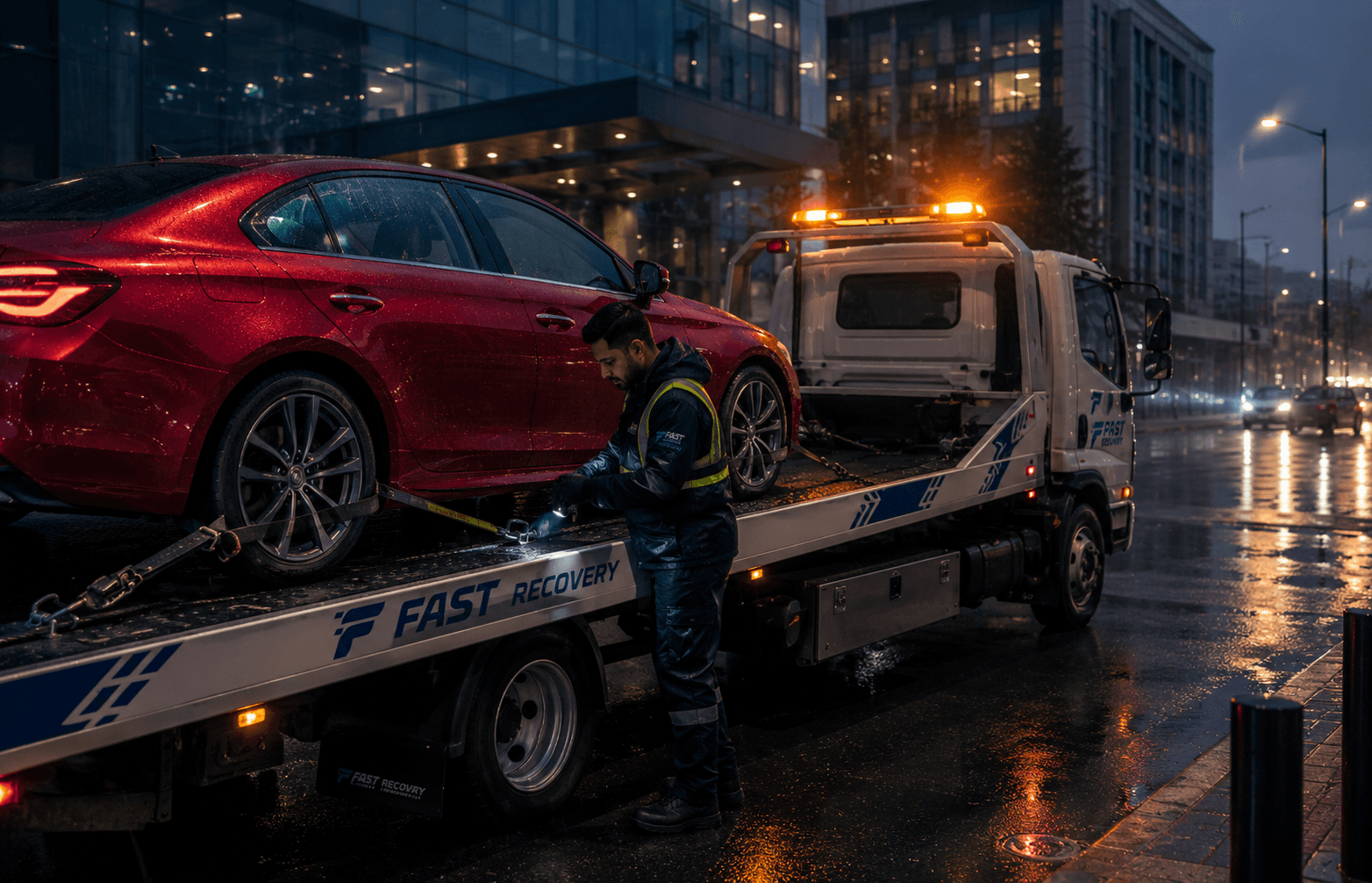
What information does a vehicle-recovery provider need?
Send the exact pickup point, vehicle details, what happened, current condition, access restrictions and destination before dispatch.
Copy-ready message: Location shared. Silver Toyota Camry with a flat front-left tyre on Airport Road towards Dubai International Airport. The car starts, steers and brakes, but I have not moved it. It is in a service lane with clear truck access. I need transport to [destination].
Why should you send vehicle details before recovery is dispatched?
The recovery provider uses your information to understand the problem, assess access and identify suitable equipment. A location pin alone does not show whether the car can roll, whether a wheel is locked or whether a flatbed can enter the parking area.
The objective is not to diagnose the vehicle through WhatsApp. It is to provide enough reliable information for the next recovery decision.
- Whether roadside assistance may be sufficient
- Whether transport is required
- Whether flatbed or wheel-lift transport may be considered
- Whether winching, dollies or wheel skates may be required
- Whether the recovery vehicle can access the location
- Whether a height restriction is relevant
- Whether accident or emergency instructions take priority
- Where the vehicle should be delivered
- What service scope should be priced and confirmed
What are the essential details to send first?
Begin with six groups of information: location, vehicle details, what happened, current condition, access and destination.
Exact location
- Live location or fixed map pin
- Road name and direction of travel
- Nearest exit or landmark
- Parking entrance or level
- Current vehicle position
Vehicle details
- Make and model
- Vehicle type and colour
- Model year where useful
- Registration number only where requested
What happened
- Breakdown or battery problem
- Flat tyre or overheating
- Warning light or accident
- Stuck vehicle or non-running transport
- Another visible issue
Current condition
- Whether it starts, rolls, steers and brakes
- Whether neutral can be selected
- Whether the parking brake releases
- Whether tyres or wheels are damaged
Access information
- Basement level and height restriction
- Narrow ramp, security gate or limited turning space
- Controlled airport access
- Busy-road position
Destination
- Workshop, dealership, home or storage
- Another parking location
- Destination not yet decided
When some information is unknown, say that it is unknown rather than guessing.
What location details should you send for vehicle recovery?
Send a clickable live location or fixed map pin, then add the road direction, nearest landmark and access instructions. A pin may identify the area without identifying the correct carriageway, entrance or basement level.
On a divided road, a recovery vehicle may not be able to reach the opposite carriageway without travelling to another exit. Direction of travel is therefore as important as the road name.
Good example: Sheikh Zayed Road towards Abu Dhabi, after Exit 47, stopped on the hard shoulder.
Weak example: I am on Sheikh Zayed Road.
- Live location or dropped pin
- Road or street name and direction of travel
- Nearest exit, junction or interchange
- Visible landmark
- Hard shoulder, service road or parking area
- Building and correct vehicle entrance
- Parking level, bay or zone
- Height restriction
- Security or access requirement
Which vehicle details should you provide?
Provide the make, model and vehicle type so the recovery provider can consider approximate size, ground clearance, drivetrain and handling requirements.
These details may affect recovery-vehicle suitability, loading angle, wheel-lift compatibility, flatbed consideration, height and weight planning, electric-vehicle instructions, attachment points and loading space.
If you do not know the drivetrain or exact variant, send the full make and model and say that the remaining details are unknown. Do not inspect labels or components from an unsafe roadside position.
- Manufacturer and model
- Saloon, hatchback, SUV, crossover, sports car or light commercial vehicle
- Approximate model year where relevant
- Colour
- Electric, hybrid or combustion vehicle
- Front-, rear-, all- or four-wheel drive where known
- Modified suspension or unusually low ground clearance
- Registration number where operationally required
How should you describe the problem?
Describe what happened in plain language and include what the vehicle did immediately before it stopped. Do not provide a mechanical diagnosis unless it has already been confirmed.
Messages such as “car problem,” “need towing,” “vehicle not working,” “come quickly” or “I am stuck” are too vague. A short factual description is more useful than a long message built around assumptions.
- The engine will not start.
- The dashboard lights come on, but the engine does not turn.
- The vehicle starts and then stops.
- The front-right tyre is flat or the wheel appears damaged.
- The engine-temperature warning appeared or coolant appears to be leaking.
- The vehicle was involved in a collision.
- The steering wheel turns, but the wheel does not appear aligned.
- The car is stuck in park or has no electrical power.
- The car is running but should not be driven.
- I need the vehicle transported even though it is running.
Why should you say whether the vehicle can roll, steer and brake?
A non-running vehicle may still roll and steer, while a running vehicle may have locked wheels or damaged steering. These details can affect loading, positioning and equipment.
Example: The engine does not start, but neutral can be selected. The parking brake releases, all four wheels roll and the steering works.
Do not push, steer or test the vehicle where doing so would expose anyone to active traffic or cause further damage.
- Whether the engine starts
- Whether neutral can be selected
- Whether the parking brake releases
- Whether all wheels rotate
- Whether steering and brakes work
- Whether the vehicle can be pushed safely
- Whether wheels are straight or turned
- Whether a wheel is locked
- Whether the vehicle is leaning or sitting unusually low
What should you report about damaged tyres or wheels?
State how many tyres or wheels are affected and whether the vehicle can roll. A single accessible flat tyre may require different equipment from a broken rim, locked wheel or damaged suspension.
Example: Front-left tyre is fully flat. The rim does not appear broken, but I have not moved the vehicle. The car is on level ground away from active traffic.
A photograph can show visible condition but cannot confirm hidden mechanical damage.
- Number and position of affected tyres
- Deflated, torn or separated tyre
- Visible wheel or rim damage
- Wheel angle and whether it rotates
- Whether bodywork contacts the tyre
- Whether the vehicle is leaning
- Visible suspension damage
- Presence of a usable spare where tyre assistance is being considered
What information should you send after an accident?
Deal with injuries, fire and immediate road danger before arranging routine recovery. Once official instructions allow recovery, share the vehicle position, visible damage, wheel condition and scene access.
- Whether anyone is injured
- Whether emergency services were contacted
- Whether police instructions were received
- Whether the vehicle may be moved
- Vehicle position
- Visible front, rear or side damage
- Airbag deployment
- Damaged wheels or suspension
- Fluid leakage, smoke or fire
- Obstructed doors, bonnet or boot
- Whether the vehicle rolls or steers
- Accident-report status where applicable
Which photographs should you send before recovery?
Send only photographs that can be taken safely. Useful images show the complete vehicle, damaged wheels, vehicle position and available recovery access.
A short video may help show tight parking access, a wheel that will not rotate, unusual vehicle position, limited loading space or underground ramp dimensions.
Do not stand in a live lane, crawl under the vehicle, touch leaking fluid, open a hot cooling system, walk around the traffic-facing side, record while driving or expose unrelated personal information.
Avoid showing passengers, personal documents, payment cards, children, accident victims or unrelated number plates.
- 1
Complete vehicle from a safe distance
- 2
Front or rear position
- 3
Damaged tyre or wheel
- 4
Visible accident damage
- 5
Ground clearance
- 6
Parking entrance
- 7
Height-restriction sign
- 8
Ramp or narrow access
- 9
Dashboard warning where safe
- 10
Nearby road sign or landmark
What access details are needed for basement or restricted parking?
Underground recovery requires information about the parking entrance, height, ramps and available working space. A location pin above the building is not enough.
A full-size flatbed may not be able to enter every basement. The vehicle may require repositioning or extraction to an accessible area before transport. Basement access cannot be guaranteed without actual measurements and assessment.
- Building or property name
- Exact vehicle entrance
- Parking level and bay or zone
- Height limit
- Ramp width and turning space
- Gate width and speed bumps
- Sharp ramp transitions
- Security-access procedure
- Whether the vehicle rolls
- Whether it can be moved to a loading area
- Photograph of the entrance and height sign
What should you send for recovery near Dubai International Airport?
Send the terminal, arrivals or departures area, parking building, level, access road and exact entrance. Airport facilities can have several controlled approaches that one pin does not explain.
Example: Terminal 1 arrivals parking, Level 3, Row C, close to Lift Lobby 2. Height limit is 2.1 metres. Vehicle does not start but can roll and steer.
- Terminal number
- Arrivals or departures
- Parking building and level
- Row, bay or zone
- Lift lobby
- Access road and entrance gate
- Height limit
- Security instructions
- Vehicle position
- Live location or entrance pin
Why should you confirm where the vehicle needs to go?
The destination affects transport distance, route planning, unloading access and the final service scope. Provide it before dispatch where possible.
Send the destination name, map link or address, contact person, relevant opening hours, gate or unloading access, parking level, height restriction and whether the destination agreed to receive the vehicle.
When unknown, say: Destination not yet confirmed. Please provide the recovery option for collection first and explain what information will be required before transport.
- Workshop
- Dealership
- Tyre shop
- Home
- Storage location
- Office parking
- Another residential or commercial property
What should you confirm before recovery is dispatched?
Confirm the service type, pickup location, destination, known access restrictions and price before dispatch. Ask what is included and what could change if the actual condition differs.
Transparent confirmation protects both the driver and provider from misunderstandings caused by missing or inaccurate details.
- Roadside assistance, towing or flatbed recovery
- Pickup point and destination
- Vehicle type and known damage
- Basement or access requirements
- Loading or winching requirements
- Quoted price and included scope
- Payment method
- Conditions that could alter the price or method
What information should you avoid sharing unnecessarily?
Share only what is required to arrange and complete recovery. Do not send sensitive documents, passwords or payment information through ordinary chat unless a verified process requires it.
A registration number may help identify the correct vehicle, but send it only through the verified service conversation and only when requested. Sensitive identity or payment credentials are not required for an ordinary initial recovery request.
- Banking password
- Card PIN or one-time password
- Complete payment-card image
- Passport copy
- Emirates ID copy unless a verified process specifically requires it
- Vehicle documents without a confirmed reason
- Personal information unrelated to pickup or destination
- Login credentials
- Sensitive unrelated photographs
What should a complete recovery request message look like?
A useful request combines a clickable pickup location with the vehicle, condition, access and destination details in a short factual message.
Standard breakdown
Hello, I need vehicle recovery. My location is [map link]. I am on [road] towards [direction], near [exit or landmark]. The vehicle is a [colour, make and model]. It does not start, but it can roll, steer and brake. Access is clear. Destination: [destination].
Flat tyre
Hello, I have a flat [wheel position] tyre. My vehicle is a [make and model] at [map link]. It is parked away from active traffic. The vehicle starts and the other wheels appear normal. I have/do not have a usable spare. Destination: [destination if recovery is needed].
Accident-damaged vehicle
Police instructions have been followed and recovery can proceed. The vehicle is a [make and model] at [map link]. Damage is visible on [area]. The [wheel position] wheel does not appear aligned, and the vehicle should not be driven. Photos are attached. Destination: [destination].
Underground parking
My vehicle is in [building], Basement [level], Bay [number]. Entrance pin: [map link]. Height limit: [height]. The vehicle [starts/does not start], [can/cannot] roll and [can/cannot] steer. Photos of the entrance and vehicle are attached.
Airport parking
Vehicle is in Dubai International Airport Terminal [number], [arrivals/departures] parking, Level [number], Zone [zone], near [lift lobby]. Entrance pin: [link]. Height limit: [height]. Vehicle condition: [condition]. Destination: [destination].
Which missing details can delay vehicle recovery?
Missing location, condition, access or destination details can lead to the wrong approach, equipment or service scope.
- Sending a screenshot instead of a clickable map link
- Omitting direction of travel or pinning the opposite carriageway
- Sending the destination instead of the pickup point
- Writing only “car not working”
- Omitting the make and model
- Not mentioning locked or damaged wheels
- Forgetting basement level or height
- Not saying whether the vehicle can roll
- Moving after sending a fixed pin without updating the provider
- Hiding accident or suspension damage
- Sending unclear photographs
- Forgetting the intended destination
- Assuming every truck can enter every parking structure
- Selecting a method only by its quoted price
What happens after FAST RECOVERY receives your information?
FAST RECOVERY reviews the submitted details, confirms missing information and assesses an appropriate service before dispatch.
- 1
Details are reviewed
FAST RECOVERY reviews the location, vehicle and problem information.
- 2
Missing details are confirmed
You may be asked about wheel movement, steering, parking access or destination.
- 3
Suitable service is considered
Roadside assistance, towing, flatbed recovery or another appropriate setup is reviewed.
- 4
Scope and price are confirmed
The service, pickup point, destination and price are explained before dispatch.
- 5
Recovery is coordinated
The suitable recovery vehicle and equipment are arranged.
- 6
Driver approaches the location
Keep your phone available for road, access or landmark questions.
- 7
Vehicle is assisted or transported
The roadside task is completed or the vehicle is taken to the agreed destination.
Response time depends on traffic, location, access, vehicle condition and recovery-vehicle availability.
Frequently asked questions
A towing or recovery provider normally needs your exact location, vehicle make and model, what happened, current vehicle condition, access restrictions and destination. Explain whether the vehicle starts, rolls, steers, brakes and shifts into neutral.
No. Describe the symptoms and what happened rather than guessing the mechanical cause. Information such as warning lights, unusual sounds, visible leaks and whether the vehicle starts is usually more helpful than an uncertain diagnosis.
The make and model help the provider consider the vehicle’s size, ground clearance, drivetrain and possible transport requirements. The exact recovery method still depends on the current condition and manufacturer instructions.
Use a fixed pin when the vehicle will remain stationary and the marker is accurate. Use live location when your position may change or the recovery driver needs updated movement. Always add the road direction and access details.
Useful photographs include the complete vehicle, visible damage, affected tyres or wheels, the vehicle’s position and restricted access. Take them only from a safe position and do not stand in active traffic.
The answer may affect how the vehicle is positioned and loaded. A vehicle that cannot roll, steer or release its parking brake may require different loading equipment from a freely rolling vehicle.
Send the property name, exact entrance, parking level, bay or zone, height restriction, ramp access and whether the vehicle can roll and steer. Include entrance photographs where safe.
First follow police or emergency instructions. When recovery is allowed, send the location, vehicle position, visible damage, wheel and steering condition, whether fluid is leaking and the intended destination.
It is preferable because the destination affects distance, route and unloading access. When the destination is not yet known, state that clearly and ask what must be confirmed before transport.
Not for an ordinary initial recovery request. Do not send passwords, PINs, one-time codes or full payment-card images. Share only information required through a verified process.
What is the practical next step?
Prioritise safety, share clear location and vehicle information, and avoid guessing the required recovery method. FAST RECOVERY can review the reported condition, access and destination when professional assistance is needed.
About this guide
This guide was prepared to help drivers provide the information required before roadside assistance or vehicle recovery is arranged in Dubai. It explains what location, vehicle, condition, access and destination details can help a provider select the appropriate next step.
The guide provides general information. Actual requirements depend on the vehicle, problem, location, access, destination and instructions from emergency services, the vehicle manufacturer or insurer.
- Published
- 1 August 2026
- Last reviewed
- 2 August 2026
- Category
- Recovery Preparation Guide
- Written by
- FAST RECOVERY Editorial Team
- Reviewed by
- FAST RECOVERY Operations Team
- Service area
- Dubai, United Arab Emirates
Guide updates
Latest content review
Official safety references, internal service links, location examples, FAQs and structured data reviewed.
Initial publication
Initial guide published with location, vehicle-condition, access, destination, photograph and message-template guidance.
Based on what you’re reading
Recommended for this section
Recommended readingWas this guide helpful?
READER CONTRIBUTIONS
Comments and guide updates
Have a relevant question, experience or correction? Submissions will be reviewed before publication or use once secure storage is configured.
Comment guidelines
- Keep contributions relevant and do not include personal contact, vehicle-registration, insurance or sensitive information.
- Promotional spam, abusive material and unsupported safety instructions will not be published.
- Comments are reviewed and are not an emergency contact channel.
Read the Privacy Policy before sharing personal information.
Reader comments
No approved comments yet. You can submit a relevant question or observation for review once secure moderation is configured.
Share your experience or question
Comments are reviewed before publication. Your email address would never be displayed publicly.