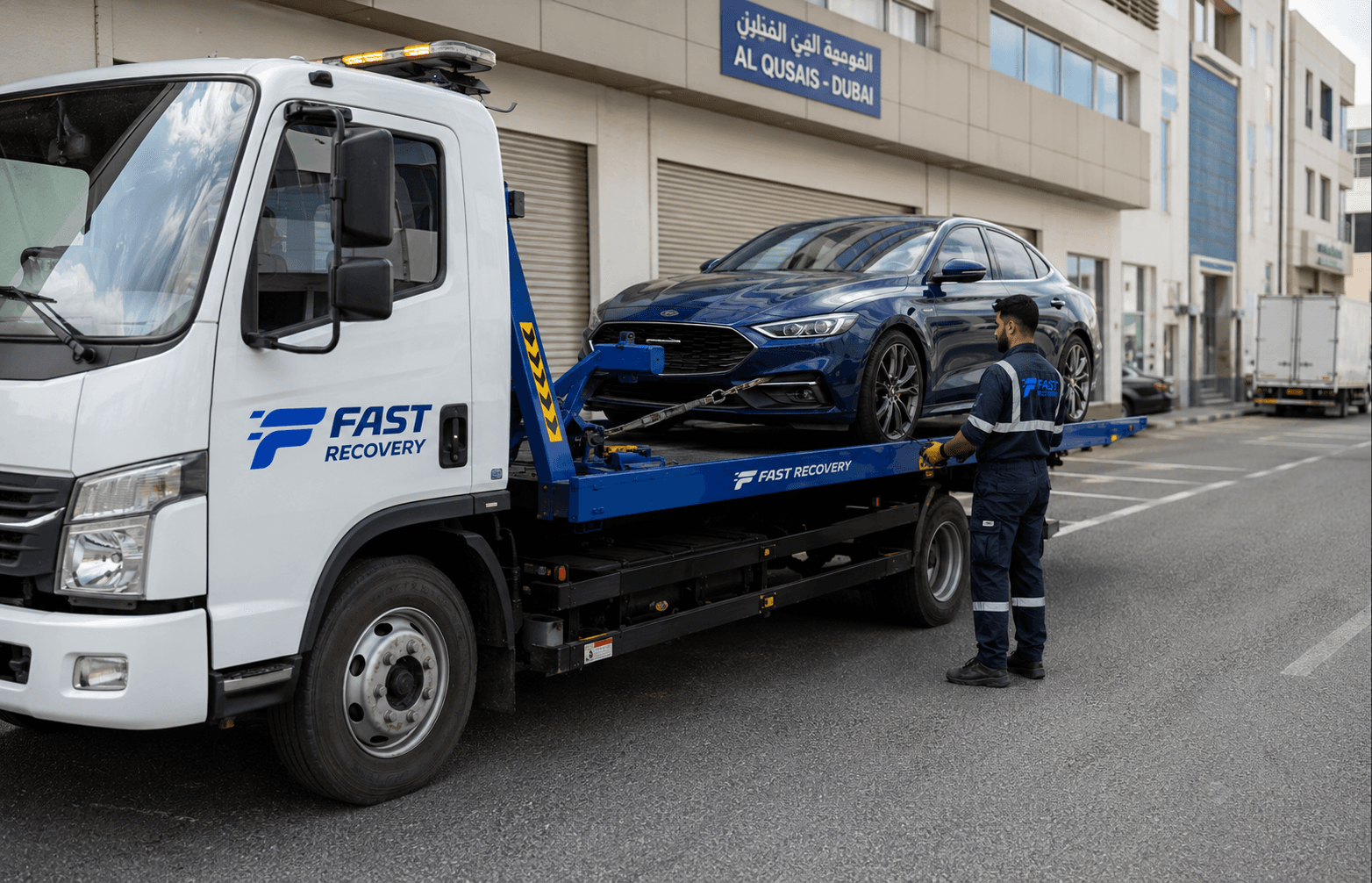
What is the difference between flatbed recovery and conventional towing?
Flatbed recovery supports the vehicle on a platform. Conventional wheel-lift towing raises one axle while other wheels may remain on the road or be supported by approved dollies.
The appropriate method depends on manufacturer instructions, drivetrain, damage, rolling and steering condition, access and destination—not price or appearance alone.
What is flatbed vehicle recovery?
Flatbed recovery uses a recovery truck with a platform on which the vehicle is loaded and secured. During transport, the recovered vehicle is supported by the platform rather than travelling with its normal road wheels rolling on the road.
- Non-running vehicles
- Accident-damaged cars
- Low-clearance cars
- Luxury and sports vehicles
- Electric vehicles where the manufacturer specifies platform transport
- AWD or 4WD vehicles where all-wheel support is required
- Vehicles with damaged wheels
- Steering or suspension damage
- Long-distance vehicle transport
- Controlled delivery to a workshop or dealership
- 1
Position the recovery truck
The recovery truck is placed in an appropriate loading area.
- 2
Lower the platform
The platform is lowered or tilted for controlled access.
- 3
Load the vehicle
The vehicle is driven, rolled or winched onto the platform.
- 4
Check position and clearance
Loading position, ground clearance and bodywork clearance are reviewed.
- 5
Secure the vehicle
Suitable restraint points and equipment are used.
- 6
Return the platform
The platform is returned to its transport position.
- 7
Transport the vehicle
The vehicle is moved to the agreed destination.
What does conventional towing mean?
In this guide, conventional towing means wheel-lift towing. A recovery vehicle lifts one axle while another set of wheels may remain on the road. Approved dollies may sometimes support the remaining wheels when the vehicle or manufacturer’s instructions require them to remain off the ground.
Conventional towing should not be selected only because the vehicle appears undamaged. Drivetrain, transmission, parking-brake condition and manufacturer instructions can affect whether its wheels may rotate during transport.
- Straightforward recovery of a compatible vehicle
- Restricted areas where a full-size flatbed cannot initially enter
- Vehicles that can roll normally on the permitted wheels
- Short repositioning or transport where the manufacturer permits the method
- Staged recovery from a confined area
- Situations where dollies provide the required wheel support
- 1
Align the towing vehicle
The towing vehicle is positioned with the stranded vehicle.
- 2
Identify the suitable axle
Drivetrain, condition and manufacturer instructions are considered.
- 3
Position the wheel lift
Wheel-lift equipment is placed and secured.
- 4
Check the raised wheels
Wheel support and attachment are inspected.
- 5
Control steering and wheel movement
Steering and the remaining wheels are prepared for transport.
- 6
Use dollies where appropriate
Approved dollies can provide additional wheel support when required.
- 7
Transport within suitable limits
The vehicle is moved according to the compatible setup and instructions.
How do flatbed recovery and conventional towing compare?
Flatbed recovery provides full platform support, while conventional towing uses a compatible wheel-lift setup and may use dollies. Neither is a universal default for every vehicle or location.
The comparison is not simply “premium method versus basic method.” Each recovery job requires a suitable combination of equipment, access, vehicle condition and manufacturer guidance.
| Comparison point | Roadside assistance | Vehicle recovery |
|---|---|---|
| Vehicle position | Loaded onto a recovery platform | One axle is lifted |
| Wheels on the road | Normally none during transport | Some may remain on the road unless dollies are used |
| Main strength | Full vehicle support during transport | Efficient transport for compatible vehicles and restricted access |
| Typical loading | Driving, rolling or controlled winching | Wheel-lift attachment and axle elevation |
| Vehicle condition | Suitable for many non-running or damaged vehicles | Requires suitable wheel, steering and drivetrain conditions |
| Low-clearance vehicles | May be suitable with the correct loading angle and equipment | Suitability depends on clearance and attachment points |
| Damaged wheels | Often better suited when controlled loading is possible | May be unsuitable unless damaged wheels are fully supported |
| AWD and EV vehicles | Often considered when all wheels need support | Only when the manufacturer permits the setup or suitable dollies are used |
| Confined access | Requires enough operating and loading space | May be more practical for initial extraction from some confined areas |
| Transport destination | Workshop, dealership, home, storage or another agreed point | Similar destinations where the method is suitable |
| Price | Depends on vehicle, access, loading and distance | Depends on vehicle, setup, dollies, access and distance |
| Final decision | Based on manufacturer guidance and vehicle condition | Based on manufacturer guidance and compatible towing setup |
Is flatbed recovery always better than conventional towing?
No. Flatbed recovery offers full platform support, but it is not automatically the only suitable method for every vehicle or location. A properly selected wheel-lift setup may be appropriate for compatible vehicles, while a flatbed may be preferable or required for others.
The best method is the method that matches the vehicle and recovery situation. The truck type alone does not determine the quality of the recovery; correct assessment, loading, restraint and transport procedures also matter.
Why flatbed recovery may be preferred
- All wheels remain supported.
- There is no normal wheel rotation against the road.
- It can accommodate many non-running vehicles.
- It enables controlled winching.
- It may suit damaged, low-clearance or specialist vehicles.
- It may align better with manufacturer transport instructions.
Why wheel-lift towing may still be appropriate
- The vehicle manufacturer permits it.
- The suitable drive axle can be lifted.
- The remaining wheels and transmission can rotate safely.
- Dollies can provide additional support.
- The location has restricted access.
- A staged extraction is required before transfer to another recovery vehicle.
Does the vehicle’s drivetrain affect the towing method?
Yes. Front-wheel drive, rear-wheel drive, all-wheel drive, four-wheel drive and electric drivetrains can have different transport requirements. The owner’s manual and manufacturer instructions should be checked because the drivetrain label alone is not enough.
Front-wheel-drive vehicles
- A wheel-lift method may sometimes raise the driven front axle.
- Remaining rear wheels must still be suitable for road rotation.
- Vehicle condition and manufacturer instructions must allow it.
- A flatbed remains an option when the condition or journey makes it preferable.
Rear-wheel-drive vehicles
- The driven rear axle may need to be raised or otherwise supported.
- Steering must be controlled.
- Transmission and manufacturer requirements must be considered.
- Flatbed recovery may be appropriate where normal wheel rotation is unsuitable.
All-wheel-drive and four-wheel-drive vehicles
- Do not assume every AWD or 4WD vehicle follows the same transport rule.
- Some vehicles require all four wheels to remain off the road.
- Some may allow specific wheel-lift and dolly configurations.
- Manufacturer instructions take priority over generic assumptions.
Electric vehicles
EV transport requirements vary by manufacturer and model. The vehicle may require a dedicated transport or tow mode, its wheels should not rotate contrary to manufacturer instructions, and high-voltage accident damage requires appropriate professional assessment.
Manufacturer instructions can be highly specific. Tesla’s UAE Model S manual, for example, recommends a flatbed or comparable transport vehicle and states that all four tyres should remain off the ground during transport. This is a model-specific example and should not be treated as a universal rule for every electric vehicle.
How does vehicle damage affect the recovery method?
Vehicle condition can be more important than vehicle type. A normally compatible car may require flatbed or specialised recovery when its wheels, steering, suspension, braking system or bodywork are damaged.
- Can the vehicle roll, steer and brake?
- Can it shift into neutral and release the parking brake?
- Can its normal tow point be accessed?
- Can it clear the loading angle?
- Can its wheels rotate normally?
- Can it be secured without contacting damaged bodywork?
Damaged tyres or wheels
Flatbed recovery or dollies may be required when multiple tyres are damaged, a wheel cannot rotate, a rim is broken or severely deformed, a tyre cannot safely remain against the road, or suspension position prevents normal movement.
Steering or suspension damage
Conventional towing may not be suitable when the vehicle cannot track normally, wheels are turned or locked unsafely, suspension parts are collapsed or displaced, bodywork contacts the tyres, or steering cannot be controlled.
Accident damage
Accident recovery may require police or emergency instructions first, scene-safety assessment, winching, wheel skates or dollies, controlled loading, additional restraint planning and appropriate handling of leaking or damaged components.
Which recovery method may suit different vehicles?
Vehicle type provides useful context, but condition, access and manufacturer instructions determine whether flatbed, wheel-lift, dollies or another setup is appropriate.
Low-clearance or sports car
Likely consideration: Flatbed recovery with a suitable loading angle. The provider must consider front and rear overhang, ground clearance, loading angle, tow-eye location, suspension mode, and wheel and bodywork protection. Not every flatbed can load every low-clearance vehicle.
Luxury vehicle
Likely consideration: Controlled flatbed loading where appropriate. The decision should reflect manufacturer instructions, ground clearance, drivetrain, approved loading points, restraint requirements and condition—not price alone.
AWD or 4WD vehicle
Required approach: Verify the manufacturer’s transport instructions. Flatbed transport may suit vehicles whose wheels must remain off the ground, while certain models may permit a wheel-lift and dolly configuration.
Electric vehicle
Required approach: Check the model-specific transport procedure, including transport mode, approved tow eye, permitted wheel rotation, battery and high-voltage condition, loading instructions and accident precautions.
Vehicle with one flat tyre
Possible options: Tyre assistance, wheel-lift towing or flatbed recovery. The choice depends on safe tyre replacement, wheel damage, affected tyre count, road position, drivetrain and destination.
Vehicle with locked wheels
Likely consideration: Controlled loading with dollies, skates, winching or a flatbed. Do not drag locked wheels onto a platform without suitable equipment and assessment.
Non-running but otherwise undamaged vehicle
Possible options: Flatbed or compatible wheel-lift towing. The provider must determine whether neutral can be selected, the parking brake releases, wheels roll, steering works and the manufacturer permits the setup.
Accident-damaged vehicle
Likely consideration: Flatbed or specialised accident recovery. Police and emergency instructions take priority when there is injury, fire, road obstruction or another immediate danger.
Does the recovery location affect the towing method in Dubai?
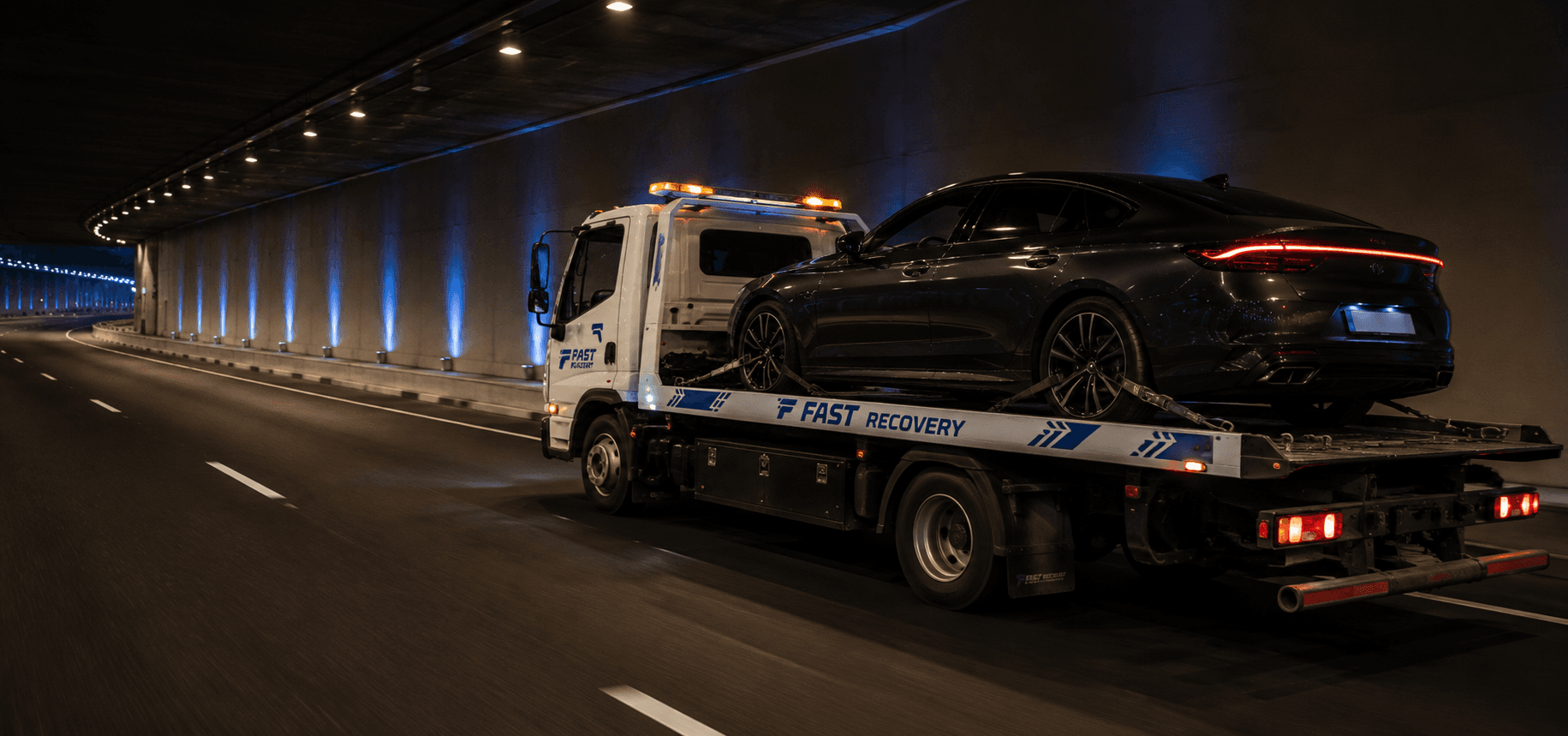
Yes. A method that suits the vehicle may not be immediately usable in a basement, narrow service road, airport parking area, tunnel or exposed high-speed road. The plan must account for both the vehicle and available working space.
Underground and basement parking
Share the parking level, height restriction, ramp width, turning space, entry-gate width, security requirements, whether the vehicle can roll and whether it can reach an accessible loading area.
A compact recovery method may be required to extract or reposition the vehicle before transfer to a flatbed in an accessible area.
Dubai International Airport
Share the terminal, arrivals or departures area, parking building and level, access road, height restrictions, controlled-entry details and exact live location.
High-speed roads
Safety takes priority over method comparison. When a vehicle creates an immediate traffic danger, emergency instructions should be followed before routine recovery is arranged.
Tunnels and restricted roads
- Follow road signs and official instructions.
- Share the direction of travel.
- Provide the tunnel, exit or nearest marker.
- Do not attempt roadside loading where it would create additional danger.
Does the recovery truck alone determine safe vehicle transport?
No. The recovery method matters, but loading, attachment points, wheel position, restraint equipment and operator assessment also affect how the vehicle is transported.
A flatbed should not be presented as damage-proof, and conventional towing should not be presented as automatically harmful. Either method must be selected and performed correctly.
- Approved tow eye or attachment point
- Suitable winch position
- Vehicle alignment
- Ground-clearance checks
- Wheel skates or dollies where required
- Correct restraint points
- Avoiding contact with body panels
- Final loading inspection
- Destination and unloading access
Does flatbed recovery cost more than conventional towing?
The final price depends on the entire recovery job rather than the truck category alone. Flatbed recovery and wheel-lift towing can each involve additional equipment, access work or repositioning.
Request confirmation of the method, service scope, destination and price before dispatch. Do not choose a method solely because its initial quote is lower.
- Vehicle size and weight
- Vehicle condition
- Flatbed, wheel-lift, dolly or other equipment
- Ability to roll and steer
- Winching requirements
- Accident damage
- Pickup location
- Basement or restricted access
- Transport distance
- Destination access
- Loading and unloading difficulty
- Operational availability
How does FAST RECOVERY confirm the suitable method?
FAST RECOVERY reviews what happened, vehicle details, access, condition and destination before confirming an appropriate flatbed, wheel-lift, dolly or other recovery setup.
- 1
Explain what happened
Describe the breakdown, accident or reason for transport.
- 2
Share the vehicle details
Provide the make, model, drivetrain and relevant transport instructions where known.
- 3
Send the location and access information
Include a map pin, road direction, parking level and height restriction.
- 4
Confirm the vehicle condition
Explain whether the vehicle starts, rolls, steers, brakes and shifts into neutral.
- 5
Review the recovery option
FAST RECOVERY assesses whether flatbed, wheel-lift, dollies or another suitable setup is required.
- 6
Confirm the destination and price
Agree on the transport destination, service scope and price before dispatch.
- 7
Keep your phone available
The recovery driver may need location, access or vehicle information.
Response time depends on traffic, location, access, vehicle condition and recovery-vehicle availability.
Frequently asked questions
Flatbed recovery carries the vehicle on a recovery platform. Conventional wheel-lift towing raises one axle while another set of wheels may remain on the road, although dollies may be used to provide additional support. The appropriate method depends on the vehicle and recovery situation.
Not automatically. Flatbed transport supports the complete vehicle during the journey, but a correctly selected wheel-lift setup may also be appropriate for compatible vehicles. Manufacturer instructions, damage, access and loading procedures should determine the method.
Not every AWD or 4WD vehicle follows the same rule. Some require all wheels to remain off the ground, while others may permit particular wheel-lift and dolly configurations. Check the manufacturer’s instructions for the exact model.
It depends on the manufacturer and model. Some electric vehicles require all wheels to remain off the ground and may have a dedicated transport mode. The recovery provider should check the model-specific transport instructions before moving it.
It may be possible when the driven front wheels are correctly lifted and the manufacturer allows the remaining wheels to rotate during transport. Vehicle condition, journey and manufacturer guidance must still be checked.
Flatbed recovery or the use of dollies and wheel skates may be more appropriate when a wheel cannot rotate safely. The final method depends on how many wheels are damaged and whether the vehicle can be loaded without causing further contact or damage.
Not always directly. Height limits, narrow ramps and restricted turning space may prevent a normal flatbed from entering. The vehicle may first need to be repositioned or extracted using suitable low-access recovery equipment.
No recovery method can be described as completely damage-proof. Appropriate loading points, winching, clearance checks, restraint equipment and operator assessment are still important.
Not in every situation. Price depends on vehicle condition, distance, access, dollies, winching and loading difficulty. Ask for confirmation of the method and complete service scope before dispatch.
Send the make, model, drivetrain, exact location, destination and whether the vehicle starts, rolls, steers and brakes. Include photographs of damaged wheels, bodywork, parking access and the vehicle’s position where useful.
What is the practical next step?
Prioritise safety, share clear location and vehicle information, and avoid guessing the required recovery method. FAST RECOVERY can review the reported condition, access and destination when professional assistance is needed.
About this guide
This guide was prepared to help Dubai drivers understand how flatbed recovery differs from conventional wheel-lift towing. It explains how drivetrain, vehicle condition, manufacturer instructions, access and destination can influence the recovery method.
The guide provides general information and does not replace the transport instructions in a vehicle owner’s manual, advice from the vehicle manufacturer, emergency-service instructions or an assessment of the actual recovery situation.
- Published
- 1 August 2026
- Last reviewed
- 2 August 2026
- Category
- Recovery Method Guide
- Written by
- FAST RECOVERY Editorial Team
- Reviewed by
- FAST RECOVERY Operations Team
- Service area
- Dubai, United Arab Emirates
Guide updates
Latest content review
Manufacturer-guidance wording, authority references, service links, FAQs and structured data reviewed.
Initial publication
Initial guide published with flatbed and wheel-lift definitions, comparison criteria, drivetrain guidance, vehicle-condition scenarios and Dubai-specific recovery considerations.
Based on what you’re reading
Recommended for this section
Recommended readingWas this guide helpful?
READER CONTRIBUTIONS
Comments and guide updates
Have a relevant question, experience or correction? Submissions will be reviewed before publication or use once secure storage is configured.
Comment guidelines
- Keep contributions relevant and do not include personal contact, vehicle-registration, insurance or sensitive information.
- Promotional spam, abusive material and unsupported safety instructions will not be published.
- Comments are reviewed and are not an emergency contact channel.
Read the Privacy Policy before sharing personal information.
Reader comments
No approved comments yet. You can submit a relevant question or observation for review once secure moderation is configured.
Share your experience or question
Comments are reviewed before publication. Your email address would never be displayed publicly.