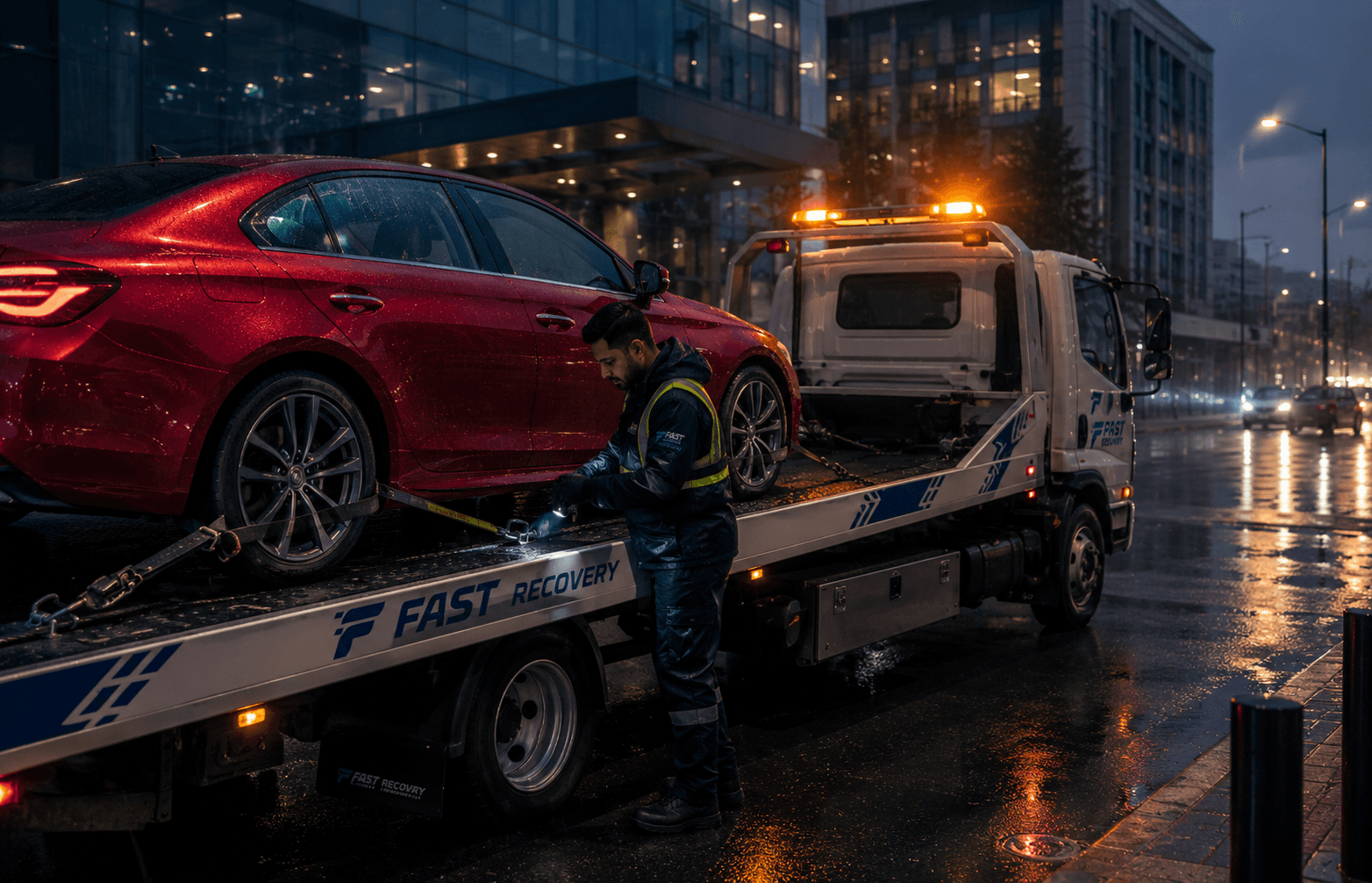
What happens after you contact a vehicle-recovery company?
The provider confirms the request, selects and prices the suitable service, dispatches an appropriate vehicle, assesses or loads your vehicle and completes the agreed roadside task or delivery.
The exact process can change according to the vehicle, damage, road position, access, destination and whether emergency-service instructions apply.
What happens immediately after you call or WhatsApp a recovery company?
The first stage is information collection, not immediate loading or transport. The provider needs to understand where the vehicle is, what happened and what type of support may be required.
A responsible provider should not confirm a recovery method based only on the words “my car is not working.”
- Current location and direction of travel
- Vehicle make and model
- What happened
- Whether the vehicle starts
- Whether it rolls, steers and brakes
- Visible tyre, wheel or accident damage
- Parking or access restrictions
- Intended destination
- Preferred contact method
Why is your location checked before dispatch?
A recovery provider needs more than a general area name. It must confirm the correct carriageway, parking entrance, terminal, basement level or service-road access before sending the recovery vehicle.
“Airport Road near Terminal 1” may still be incomplete because the vehicle could be on the main carriageway, service road, arrivals approach, departures approach or inside parking.
- Clickable live location or map pin
- Road name and direction of travel
- Nearest exit or interchange
- Landmark
- Hard shoulder or service road
- Property entrance
- Parking level and bay
- Height restriction
- Security or gate access
What questions will the recovery company ask about the vehicle?
The provider should ask questions that help determine whether the vehicle can be assisted where it stopped or must be transported.
These questions help plan recovery equipment and access. They should not be presented as a remote mechanical diagnosis.
- Does the engine start?
- Can neutral be selected?
- Does the parking brake release?
- Can the vehicle roll?
- Do steering and brakes work?
- Are wheels locked?
- Are tyres, wheels or suspension damaged?
- Is the vehicle low to the ground?
- Is it electric, hybrid, AWD or 4WD?
- Was it involved in an accident?
- Is fluid leaking?
- Can the vehicle be accessed from the front and rear?
How is the correct recovery service selected?
The service should reflect the problem, vehicle condition, location and destination. The request may result in roadside assistance, wheel-lift towing, flatbed recovery or another appropriate setup.
The provider may change the initial recommendation if new information or visible damage is discovered on arrival.
| Situation | Appropriate action |
|---|---|
| Weak battery in a safe location | Battery jump-start or roadside assistance |
| Accessible single flat tyre | Flat tyre assistance |
| Vehicle will not start after basic assistance | Vehicle recovery |
| Vehicle cannot roll or steer normally | Recovery with suitable loading equipment |
| Accident or wheel damage | Accident or flatbed recovery assessment |
| Low-clearance or specialist vehicle | Controlled loading assessment |
| Vehicle in restricted parking | Access assessment before dispatch |
| Vehicle requires transport to a workshop | Towing or flatbed recovery |
What should be confirmed before the recovery vehicle is dispatched?
Before dispatch, confirm the selected service, pickup location, destination, known access restrictions and price. Ask what is included and what circumstances could change the service scope.
- Service category and vehicle type
- Pickup location and destination
- Transport distance where relevant
- Known damage
- Access limitations
- Loading or winching requirements
- Quoted price and included scope
- Payment method
- Conditions that could change the quote
We’ll review your location and vehicle details, then confirm the suitable service and price before dispatch.
What does “dispatch confirmed” mean?
Dispatch confirmation means the provider has accepted the request and arranged a suitable recovery vehicle or roadside-assistance unit for the confirmed location and service.
Dispatch does not mean the recovery vehicle has already arrived or that road access is guaranteed. Traffic, road restrictions, parking access and actual vehicle condition can affect the next stage.
- Service type
- Pickup location
- Vehicle details
- Destination
- Agreed price or pricing basis
- Main contact number
- Preparation instructions
- Access requirements
- Update process
What communication should you expect after dispatch?
After dispatch, the provider or driver may contact you to confirm the route, landmark, parking entrance or vehicle position. Keep your phone available and report changes.
Live tracking or automatic notifications should only be promised when the system genuinely supports them. Otherwise, updates should be provided by phone or WhatsApp.
- Recovery vehicle dispatched
- Driver requires a clearer location
- Road access has changed
- Parking security needs contact
- The vehicle has been moved
- Destination details are incomplete
- Additional equipment may be required
- The driver has reached the surrounding area
What should you do while waiting for the recovery vehicle?
Remain in the safest available location, keep your phone accessible and avoid repairs or vehicle movement that could create additional danger.
- Keep hazard lights on where appropriate for the emergency stop.
- Stay away from moving traffic.
- Keep passengers in the safest available location.
- Preserve phone battery and keep location sharing active where required.
- Gather essential belongings and keep keys available.
- Confirm the destination.
- Inform parking security if access is required.
- Do not repeatedly start an overheating or visibly damaged vehicle.
- Update the provider if the vehicle is moved.
What should you prepare before the recovery driver arrives?
Preparing keys, access information and the destination can reduce avoidable delays when the driver reaches the vehicle.
Remove cash, documents, electronics, medication and other essential personal belongings before transport. The vehicle may be delivered where immediate access is limited.
- Vehicle keys or approved access
- Parking ticket, access card or security permission
- Destination address or map pin
- Workshop contact
- Essential personal belongings
- Vehicle and manufacturer transport instructions where relevant
- Insurance or police information where required
- Details of anything that changed after dispatch
What happens when the recovery driver arrives?
The driver should confirm the correct vehicle and assess its position, condition and access before roadside work or loading begins.
The recovery plan may need revision if the actual vehicle condition differs from the information provided.
- Confirming vehicle identity and the agreed request
- Reviewing road or parking safety
- Inspecting tyre and wheel condition
- Confirming whether the vehicle rolls
- Checking steering and parking-brake status
- Reviewing ground clearance
- Identifying loading or attachment points
- Confirming the destination
- Explaining any necessary change in method
What happens if the problem can be handled at the roadside?
When the location is safe and the issue fits the available roadside service, the technician may attempt the agreed assistance without transporting the vehicle.
A successful engine start does not automatically mean the vehicle is safe to drive. Warning lights, charging problems, overheating, damaged tyres or steering issues may still require recovery or workshop inspection.
- Battery jump-start completed
- Accessible tyre assistance completed
- Limited roadside assessment completed
- Vehicle starts and can continue safely
- Problem remains and recovery is recommended
What happens if the vehicle needs to be transported?
The driver positions the recovery vehicle, prepares the loading equipment, moves or winches the vehicle into the correct position and secures it before transport.
The actual procedure depends on the vehicle and recovery method; not every vehicle follows the same sequence.
- 1
Establish a safe working position.
- 2
Confirm the loading direction.
- 3
Check tow points and ground clearance.
- 4
Release or manage the parking brake.
- 5
Select neutral where possible.
- 6
Use winching, skates or dollies where required.
- 7
Load or lift the vehicle.
- 8
Check alignment.
- 9
Apply suitable restraints.
- 10
Complete a final security check.
Why might the recovery method or price change after arrival?
The method or service scope may change when actual vehicle condition, damage or access differs from the information provided before dispatch.
Any material change in method, scope or price should be explained before additional work proceeds, unless urgent safety instructions require immediate action.
- A wheel is locked or suspension damage was not visible.
- Neutral cannot be selected or the parking brake will not release.
- A basement is lower or narrower than expected.
- The vehicle cannot be reached from the shared entrance.
- Additional winching is required.
- The destination has restricted unloading access.
- The vehicle is larger or heavier than reported.
- Accident damage requires additional handling.
- Police or security instructions change access.
What happens while the vehicle is being transported?
Once secured, the vehicle is transported to the agreed destination. Receiving arrangements should be confirmed before or during collection.
Passenger transport depends on the recovery vehicle, operator policy, available seating, insurance and safety requirements. Confirm this separately rather than assuming it is included.
- Correct destination
- Route and access
- Workshop opening hours
- Receiving contact
- Parking or unloading restrictions
- Vehicle keys
- Police or insurance requirements where applicable
What happens when the vehicle reaches the destination?
At the destination, the driver confirms the unloading area, positions the recovery vehicle safely and hands over the vehicle according to the agreed instructions.
Confirm that the destination is open, someone can receive the vehicle, unloading space is available, height or gate restrictions are known and the vehicle will not be left in an unauthorised position.
- Contacting the workshop or receiving person
- Confirming unloading access
- Rechecking ground clearance
- Removing restraints and controlled unloading
- Positioning the vehicle
- Handing over keys
- Confirming visible condition and service completion
- Completing payment or receipt requirements
What should you receive after the recovery service?
Keep a record of the agreed service, destination, amount paid and completion details. Request an invoice or receipt where applicable.
Do not share card PINs, banking passwords or one-time verification codes through an ordinary recovery conversation.
- Service date
- Pickup location and destination
- Vehicle details
- Service type
- Agreed and final price
- Payment confirmation
- Invoice or receipt
- Workshop handover confirmation
- Relevant photographs
- Police or insurer reference where applicable
Does the process change for accidents, airports or underground parking?
Yes. Some locations and vehicle conditions require additional confirmation before dispatch or loading.
What should you expect at each recovery stage?
| Stage | Recovery company’s role | Your role |
|---|---|---|
| Initial contact | Ask what happened | Give a factual description |
| Location check | Confirm access and direction | Send a pin and road details |
| Vehicle assessment | Identify likely equipment | Describe whether it rolls, steers and brakes |
| Service confirmation | Explain the suitable option | Confirm the service and destination |
| Price confirmation | Explain the quoted scope | Ask what is included |
| Dispatch | Arrange the recovery vehicle | Keep your phone available |
| Arrival | Inspect the position and condition | Provide keys and access |
| Loading or assistance | Perform the agreed service | Remain clear of equipment |
| Transport | Move the vehicle securely | Confirm the receiving destination |
| Handover | Unload and complete the service | Check records and payment |
Accident recovery
- Emergency or police instructions
- Accident location and report status
- Visible damage
- Wheel and suspension condition
- Fluid leakage
- Whether the vehicle may be moved
- Approved destination
Underground parking
- Entrance pin
- Level and bay
- Height restriction and ramp dimensions
- Security access
- Whether repositioning is required before flatbed transfer
Dubai International Airport
- Terminal and arrivals or departures
- Parking building and level
- Access road
- Height restriction
- Entry instructions and exact entrance
High-speed road or tunnel
Emergency and road-authority instructions take priority over an ordinary recovery process.
Frequently asked questions
The provider should first ask for your location, vehicle details, what happened, current vehicle condition and destination. This information helps determine whether you need roadside assistance, towing, flatbed recovery or another recovery setup.
The service scope and price should be confirmed before dispatch where possible. Ask what is included and whether vehicle damage, restricted access, winching or a destination change could affect the final amount.
It means the provider has accepted the request and arranged a recovery or roadside-assistance vehicle for the confirmed service and location. It does not mean the driver has already arrived.
Arrival time depends on traffic, distance, road access, parking restrictions, vehicle condition and recovery-vehicle availability. Avoid relying on an unverified guaranteed time.
Remain in the safest available place, keep your phone accessible and avoid repairs or vehicle movement that could create danger. Keep the keys, destination and access details ready.
The driver should confirm the vehicle, inspect its condition and position, review access and decide how the agreed roadside or recovery service can be performed safely.
Yes. The method may change if the vehicle has locked wheels, hidden damage, restricted access or another condition that was not known before dispatch. Any material change should be explained.
Passenger transport depends on the recovery vehicle, operator policy, available seating, insurance and safety rules. Confirm this before dispatch rather than assuming it is included.
The recovery driver should unload the vehicle in the agreed area and hand over the keys or vehicle according to your instructions. Confirm that the workshop is open and able to receive it.
Keep the invoice or receipt, payment confirmation, pickup and destination details and any workshop or accident-reference information relevant to the service.
What is the practical next step?
Prioritise safety, share clear location and vehicle information, and avoid guessing the required recovery method. FAST RECOVERY can review the reported condition, access and destination when professional assistance is needed.
About this guide
This guide was prepared to help drivers understand what normally happens after contacting a roadside-assistance or vehicle-recovery provider in Dubai. It covers information collection, service confirmation, dispatch, driver arrival, loading, transport and destination handover.
The exact process may vary according to the vehicle, problem, location, access, destination and instructions from emergency services, a vehicle manufacturer, insurer, property operator or receiving workshop.
- Published
- 1 August 2026
- Last reviewed
- 2 August 2026
- Category
- Vehicle Recovery Guide
- Written by
- FAST RECOVERY Editorial Team
- Reviewed by
- FAST RECOVERY Operations Team
- Service area
- Dubai, United Arab Emirates
Guide updates
Latest content review
Process wording, official safety references, internal links, FAQs and structured data reviewed.
Initial publication
Initial guide published with contact, service confirmation, dispatch, arrival, loading, transport and handover guidance.
Based on what you’re reading
Recommended for this section
Recommended readingWas this guide helpful?
READER CONTRIBUTIONS
Comments and guide updates
Have a relevant question, experience or correction? Submissions will be reviewed before publication or use once secure storage is configured.
Comment guidelines
- Keep contributions relevant and do not include personal contact, vehicle-registration, insurance or sensitive information.
- Promotional spam, abusive material and unsupported safety instructions will not be published.
- Comments are reviewed and are not an emergency contact channel.
Read the Privacy Policy before sharing personal information.
Reader comments
No approved comments yet. You can submit a relevant question or observation for review once secure moderation is configured.
Share your experience or question
Comments are reviewed before publication. Your email address would never be displayed publicly.